
Pendant Light Size Guide: Kitchen Islands & Dining Tables
November 09, 2026
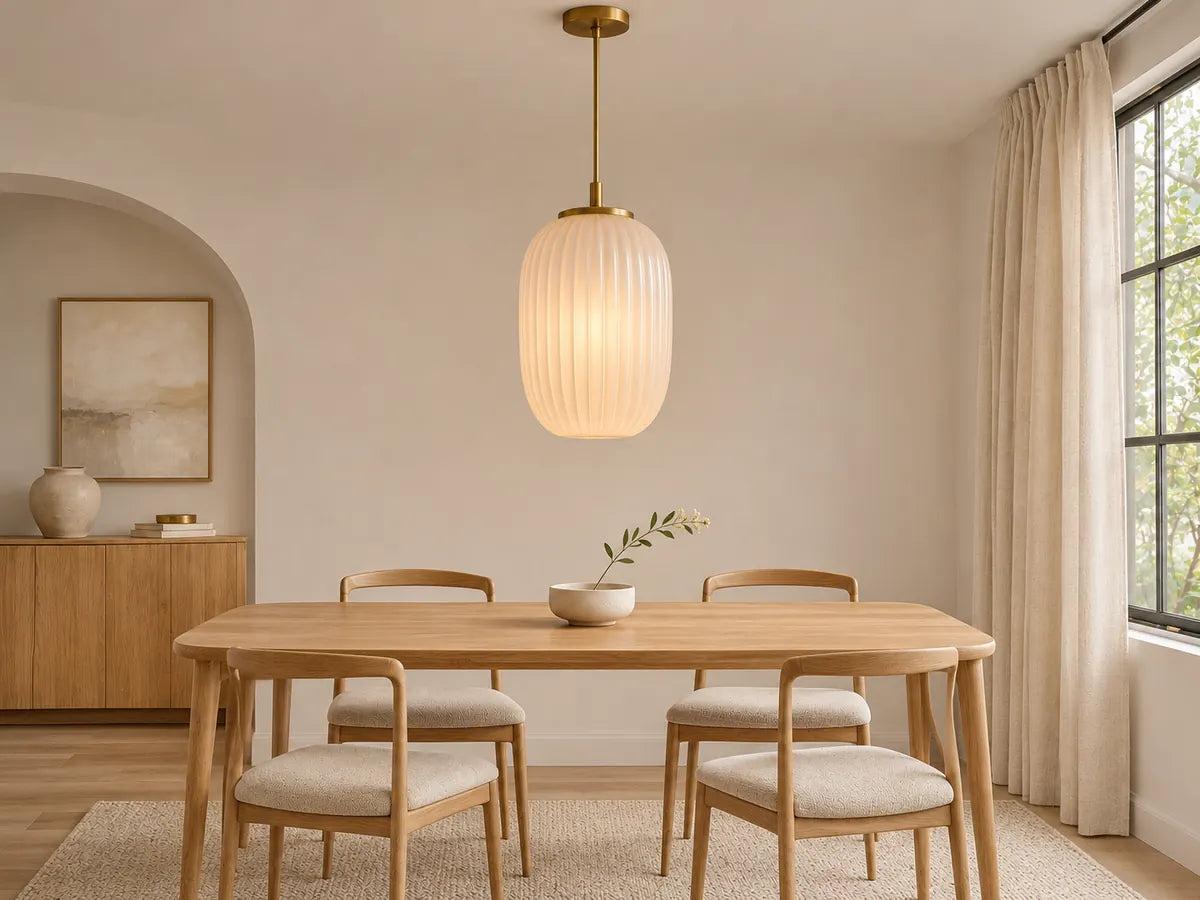
Choosing a pendant light is easier when you measure before you shop. This pendant light size guide explains how to compare fixture width, hanging height and spacing for a kitchen island or dining table, so you can choose a light that suits the surface below it.
A pendant can look beautiful in a product photograph and still feel too large, too small or too low in your home. The aim is to balance the fixture with your furniture while keeping views clear and putting light where you need it.
Start by exploring Glimvale pendant lights, then use the measurements below to narrow your choices.
Pendant Light Sizing: The Quick Answer
For a single pendant over a table, a diameter around one-third to one-half of the table width is a useful starting point. Over a kitchen island, plan the whole arrangement: the size of each shade, the number of lights and the empty space between them.
A common starting height over a tabletop or countertop is 30–36 inches from the surface to the bottom of the fixture. Treat these as design guidelines rather than universal installation requirements. Check the product instructions, actual sightlines and installation conditions before deciding.
| What to measure | Why it matters |
|---|---|
| Table or island length and width | Establishes the footprint your lighting should suit |
| Ceiling height | Helps determine whether the fixture can hang at the intended height |
| Shade width and body height | Shows how much visual and physical space the pendant occupies |
| Minimum and maximum installed height | Confirms whether the full light, including its suspension, fits |
| Distance between fixture centers | Helps you compare layouts without confusing spacing with clear gaps |
1. Measure the Furniture Before the Room
When a pendant hangs over a defined surface, begin with that surface. Record the tabletop or countertop dimensions, then mark its center. A fixture centered in the room can look misplaced if the dining table sits elsewhere.
Also consider the final furniture position. If an extendable table usually stays closed, plan around its everyday size, then check how the arrangement looks when extended. For an island with a seating overhang, consider both the work area and the view from the stools.
Take a photograph from the kitchen entrance and another from the adjoining living area. These viewpoints can reveal whether a large shade would interrupt a view you want to keep open.
2. How to Choose Pendant Light Size for a Dining Table
For one pendant above a round or square table, compare a few sizes within the one-third to one-half starting range. The table below shows the arithmetic; it is not a requirement to buy a fixture at either end of the range.
| Table width or diameter | Starting pendant diameter | How to use the range |
|---|---|---|
| 30 inches | 10–15 inches | Compare a compact shade with a more noticeable centerpiece |
| 36 inches | 12–18 inches | Check how much of the view the shade occupies |
| 42 inches | 14–21 inches | Test both the width and the height of the fixture body |
| 48 inches | 16–24 inches | Leave comfortable visual space around the table edges |
| 60 inches | 20–30 inches | Mock up the larger option before ordering |
A long rectangular table introduces another decision: whether one central light will create the composition you want. A linear fixture or a coordinated group may suit its shape better than a compact pendant.
If you prefer several light sources within one decorative fixture, compare the proportions of modern chandeliers. Measure the total fixture dimensions, including any arms or projecting shades.
3. Plan Kitchen Island Pendants as a Group
Do not select a pendant diameter in isolation and decide the quantity afterward. Sketch two possible arrangements on the same island drawing, using the actual width of the fixtures you are considering.
Two larger shades can create a simple composition, while three smaller ones create a repeated pattern. Neither quantity is automatically right. Existing ceiling connections, shade diameter, light distribution and the island layout all affect the result.
A useful geometric check is:
Arrangement length = (number of pendants − 1) × center-to-center spacing + one pendant diameter.
This calculation assumes matching round shades arranged in a straight line. It measures the distance from the outside edge of the first shade to the outside edge of the last.
Example: Three Pendants Over a 96-Inch Island
Suppose you are comparing three shades, each 12 inches wide, with their centers 30 inches apart. Their combined arrangement spans 72 inches: two 30-inch spaces plus one 12-inch diameter.
Centered over a 96-inch island, the outer shade edges sit 12 inches inside each end. The clear gap between neighboring shades is 18 inches, because 30 minus 12 equals 18.
This example checks physical fit; it does not prove that the lights provide enough illumination. You still need to consider the fixture output, shade design and other lighting in the kitchen.
4. Understand Center-to-Center Spacing
Many pendant layouts begin around 24–36 inches between fixture centers, then adjust for the shades and the surface. Center-to-center spacing is different from the empty gap between two fixtures.
For matching pendants, subtract the shade diameter from the center spacing to find the clear gap. Two 18-inch shades placed 30 inches apart have a 12-inch gap. Two 8-inch shades at the same centers have a 22-inch gap.
This is why copying ceiling connection positions from an inspiration photograph can produce a different result. Larger shades need a different visual balance, even when the room looks similar.
Mark each proposed center with removable tape and place paper circles representing the shades on the counter. Check the layout from both ends before committing to new ceiling positions.
5. Calculate the Hanging Height and Total Drop
Measure hanging height from the furniture surface to the lowest part of the fixture. Measuring only to the bulb or the middle of the shade can leave the finished light lower than intended.
For example, an 8-foot ceiling is 96 inches high. With a 36-inch counter and a chosen 32-inch gap above it, the bottom of the pendant would sit 68 inches above the floor. That leaves a 28-inch total ceiling-to-bottom drop.
The 28 inches must accommodate the complete installed assembly: canopy, suspension and fixture body, as defined in the product specification. It is not automatically the required cord length. A tall shade or long minimum stem can make that installation impossible.
Higher ceilings do not mean you should use the entire available suspension length. Check the view across the surface and the fixture's adjustment limits. Pendants over open circulation areas need a separate clearance assessment; the tabletop guidance should not be applied to a walkway.
6. Check Shape, Material and Light Output
Diameter is only part of the picture. A shallow shade and a tall enclosed shade of the same width can feel very different. Consider the fixture silhouette from eye level, rather than relying only on an overhead measurement.
Before buying, ask:
- Will a visible bulb create uncomfortable brightness from nearby seats?
- Does the shade direct light downward, outward or through a diffuser?
- Can you reach the shade and bulb for cleaning or replacement?
- Does the finish work with the nearby furniture and hardware?
Do not assume a larger pendant is brighter. Compare the specified light output and bulb requirements. If the fixture uses replaceable bulbs, check the socket type, maximum permitted wattage and bulb dimensions. For integrated LED products, review the stated output and color options.
If you want dimming, verify compatibility between the light, its bulb or driver and the intended dimmer. A feature available on one variant may not apply to every size or finish.
7. Avoid These Common Pendant Sizing Mistakes
| Common mistake | A better check |
|---|---|
| Choosing from a room photograph alone | Compare the listed dimensions with your own measurements |
| Confusing shade height with installed height | Check the full minimum and maximum ceiling-to-bottom dimensions |
| Using the same spacing for every shade size | Calculate both center spacing and clear gaps |
| Planning around an empty room | Position the table, stools and other furniture first |
| Expecting pendants to light the whole kitchen | Assess the work surface alongside the rest of the room lighting |
| Assuming a product image shows the chosen variant | Confirm the size, finish and lighting option in the selected variant |
A paper mock-up is an inexpensive final check. Cut a circle to the shade diameter or make a simple cardboard silhouette. Hold it at the proposed position and look from the seats, doorway and neighboring room.
For hardwired fixtures, have a qualified installer confirm mounting, support and electrical compatibility. Design measurements alone do not establish whether a particular installation is suitable.
Frequently Asked Questions
What size pendant light should I choose over a 36-inch table?
For one pendant, roughly 12–18 inches wide is a starting range based on one-third to one-half of the table width. Compare the fixture body height and visual weight before choosing.
How many pendant lights should go over an 8-foot island?
Compare two larger pendants with three smaller ones. Draw both arrangements using the actual shade dimensions, then check the clear gaps, end positions and light coverage. Island length alone does not decide the quantity.
How high should pendant lights hang above a kitchen island?
A common starting range is 30–36 inches from the countertop to the bottom of the fixture. Adjust for the product instructions, ceiling height, glare and sightlines.
Does pendant spacing mean the gap between the shades?
Not always. A measurement described as center-to-center runs between fixture centers. The empty gap is smaller: subtract the shade diameter when comparing two matching round pendants.
Can I shorten every pendant light?
No. Adjustment depends on the suspension design. Check the minimum installed height, supplied stems or cord, and installation instructions before ordering.
Should I choose a pendant or a chandelier?
Choose the shape and lighting arrangement that fits your furniture. Compare a single pendant, a linear fixture and a chandelier using their full dimensions rather than the product category name alone.
Choose a Pendant That Fits Your Space
Start with the furniture dimensions, test the fixture silhouette, and check the complete installed height. For multiple pendants, calculate the arrangement as a group before choosing the quantity.
Explore pendant lights for your shortlisted sizes, compare modern chandeliers for a different arrangement, or browse the wider indoor lighting collection to plan the rest of the room.